
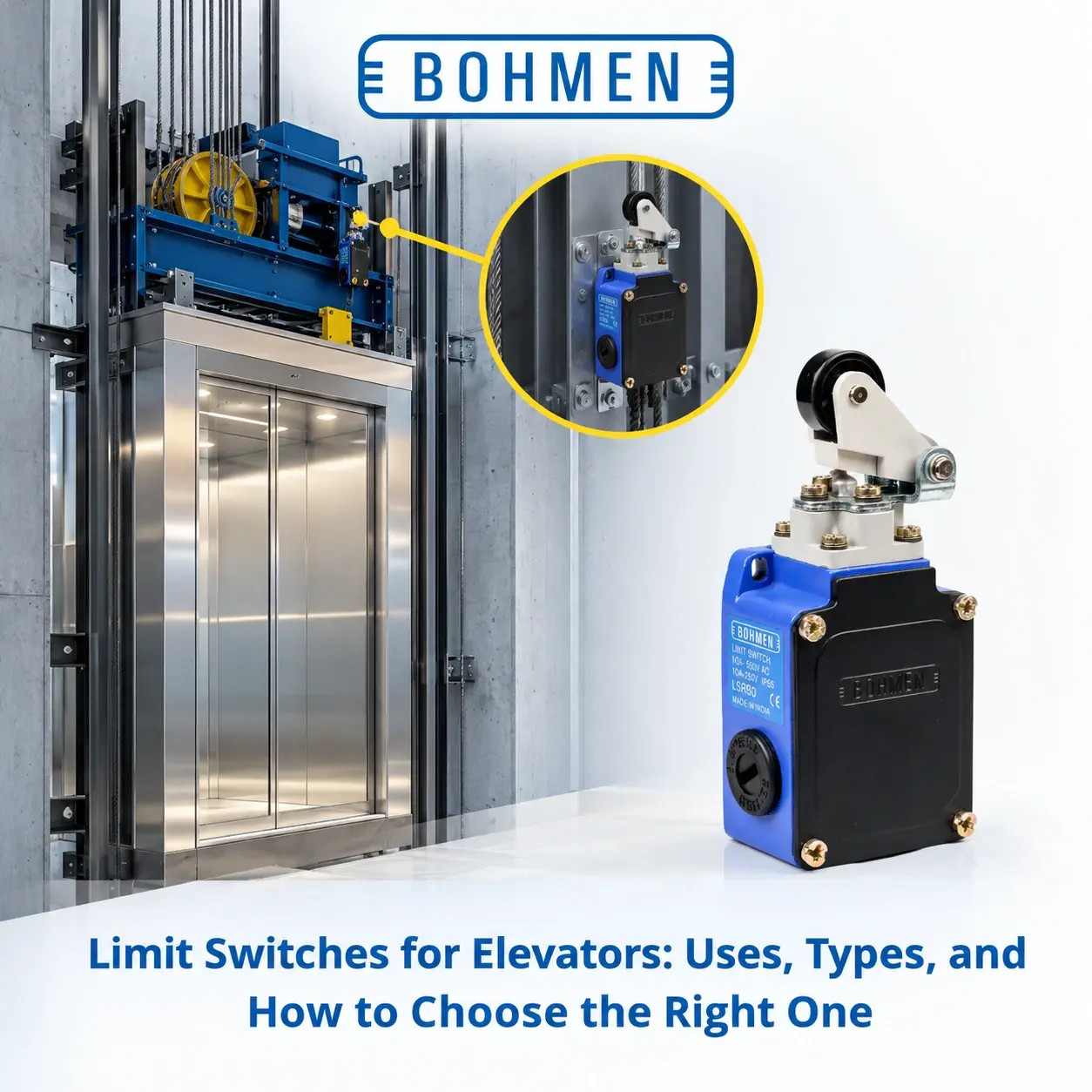
Every time an elevator stops exactly at your floor, slows down before the top landing, or refuses to move with the door open, a small electrical device is quietly doing its job. That device is the limit switch. Though it is one of the smallest components in a lift system. It plays a big part in safe and accurate movement. This guide explains how limit switches work in elevators, where it used. Also how to choose the right one for your application.
What Is a Limit Switch?
An electrical switch is triggered when a moving part makes contact with a limit switch. The contact tells the control system that something has reached the end of its travel or a particular position. In simple terms, it helps a machine understand when to stop, start, or change direction.This is why engineers use limit switches in elevators, conveyors, doors, lifts, and packaging machines. Also used in many other industrial systems for motion control, position sensing, and machine protection.
Why Limit Switches Matter in Elevators?
An elevator moves people. Also it moves goods through a fixed shaft. So it must never travel beyond its intended limits. Limit switches provide the physical signal that the car or counterweight has reached a defined position. When it receives that signal, the control system can slow the car, stop the motor, or prevent movement altogether. Because the signal comes from direct mechanical contact, it remains a dependable layer of protection even when electronic systems being serviced. For lift manufacturers and maintenance teams, a reliable limit switch means smoother operation, fewer breakdowns, and greater confidence in the safety of the installation.
Where Limit Switches Are Used in an Elevator System?
Limit switches appear in several places across a lift installation. At the top and bottom of the shaft, they act as end-of-travel switches that cut off or slow the car if it moves past its normal stopping position. Near the landings, they can support slowdown and leveling so the car stops smoothly and accurately at each floor. On the car and landing doors, the system confirms that the doors are fully closed before allowing the lift to move, which prevents the car from traveling with an open door. In the pit and machine room, engineers can use them for access panels, buffers, and other points where they need to detect a position or state.The lift manufacturer or a qualified engineer should always make these decisions, since the exact arrangement depends on the lift design and the applicable safety standards.
Bohmen India’s GL Series for Elevator Applications
Among the product ranges offered by Bohmen India, the GL Series is the one listed for elevators, alongside machine tools, packaging, and conveyors. The GL Series is positioned as a versatile general-purpose industrial limit switch with multiple actuation options. It uses a metal diecast enclosure and is available in IP43, IP65, and IP67 protection levels. It also offers a choice of slow, snap, and make-before-break contact action, and carries three ¾” BSC cable entries for flexible wiring.
The range comes in two forms. The Elements Limit Switch Blocks are open IP00 switch blocks for panel or integrated use, while the Enclosures Limit Switches are the enclosed IP43 versions that protect the contacts inside a robust housing. Having both formats helps lift OEMs choose between a compact built-in block and a complete enclosed switch.
Bohmen is based in Maharashtra, manufactures close to five lakh products a year under an ISO 9001:2015 certified manufacturing system, and has been supplying industrial limit switches for over four decades.
How to Choose the Right Limit Switch for an Elevator
Selecting a limit switch is not just a matter of picking a model, so it helps to think through a few key points.
Protection level
Choose an IP rating that suits the place where you mount the switch. For general factory conditions,commonly IP65 used. Meanwhile IP67 is better for wet, dusty, or harsh surroundings. IP43 is generally enough only for clean, dry, indoor locations. In a lift shaft or pit, where moisture or dust may be present, a higher rating is usually the safer choice. But the final decision should follow your site conditions.
Contact Action
Slow action moves the contacts gradually.Meanwhile snap action switches rapidly, which gives consistent switching regardless of how slowly the actuator moves. For applications where a precise and repeatable switching point matters, engineers often prefer snap action. Make-before-break contacts suit circuits where engineers must maintain continuity during switching.
Actuator Type
The actuator, such as a plunger, roller lever, or rotary lever, should match how the cam, striker, or door mechanism will contact the switch. A mismatch can cause wear, unreliable operation, or missed signals.
Contact Rating and Wiring
Check that the electrical rating matches the control circuit, and make sure the cable entry suits your wiring arrangement.
Durability and Wear
In a lift that runs thousands of cycles every day, wear resistance directly affects service life and maintenance frequency. Switches built with strong materials and tested mechanisms help reduce downtime.
Standards and Compliance
Elevators are safety-critical, so the switch must satisfy the standards that apply to your lift design and region. Bohmen states that it designs and tests its products as per IEC standards. For any safety-related position in a lift, you should confirm with the manufacturer that the chosen model is suitable for that function and meets your required lift standards.
Installation and Maintenance Tips
Mounting a limit switch incorrectly will cause even the best one to perform poorly.Fix it firmly so vibration does not shift its position.Also, align the actuator properly.Also check the wiring for tightness and insulation.You should properly seal cable entries to maintain the IP rating. Also check the wiring for tightness and insulation. During routine maintenance, technicians should inspect switches for wear, cracked housings, loose mounting, moisture ingress, and sluggish actuator movement. Replacing a worn switch early is far cheaper than dealing with a lift that has stopped unexpectedly.
Why Work with an Experienced Switch Manufacturer?
Lift builders need consistent quality across large volumes, quick supply, and technical support when a design has special requirements. Bohmen India works with more than 450 regular OEM customers. Also offers around 250 product variants, with custom configurations available to suit specific system needs.This kind of flexibility is useful when a standard switch does not quite fit a particular lift layout.