
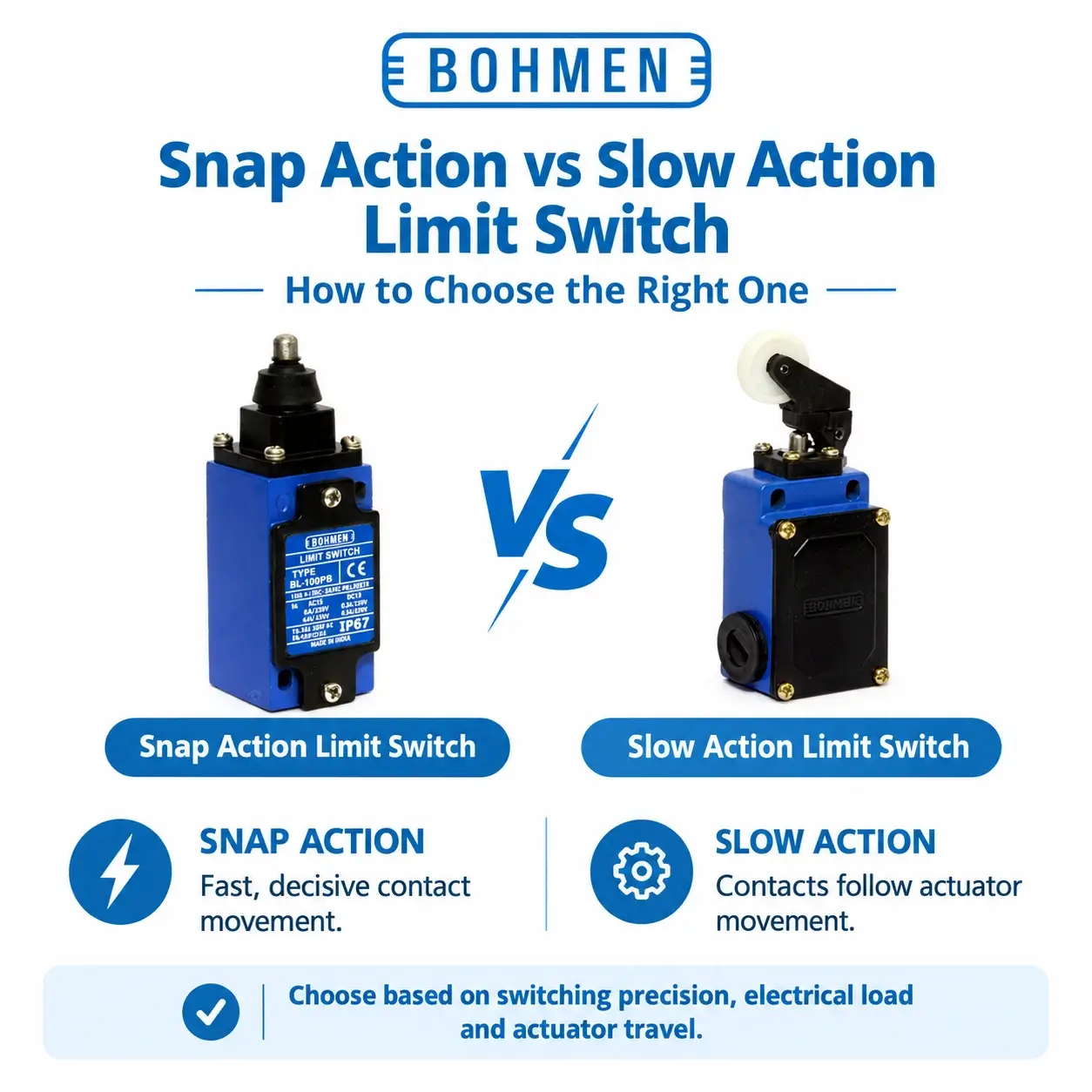
When you select a limit switch for a machine, the first things you look at are the actuator, the contact configuration and the IP rating. One more choice affects switching accuracy, contact life and reliability: snap action or slow action.Many buyers choose without knowing the difference, and then run into chattering contacts, burnt contacts or inconsistent switching. In this guide we will explain how each type works, where each fits and how to choose.
What is a Snap Action Limit Switch?
A snap action limit switch has a spring mechanism inside. When the actuator reaches a set point, the contacts jump from one position to the other almost instantly, no matter how slowly the actuator itself is moving.
Key characteristics:
- Contacts switch quickly at a fixed point
- Switching speed does not depend on how fast the machine part moves
- Faster contact movement reduces arcing, which helps contact life
- Gives a clear, repeatable switching point
- There is a small gap between the operating point and the release point (this is normal and is called differential travel)
Snap action is the most common choice in industrial machinery, because most machines need clean, dependable switching.
What Is a Slow Action Limit Switch?
Slow-action (also called creep-action) switches move contacts at the same speed as the actuator. If the actuator moves slowly, the contacts will open or close slowly. No “snap” in between in spring.
Key characteristics:
- Contact movement is following the actuator movement
- The switching point is dependent on the distance moved by the actuator
- Useful if the moving part moves very slowly
- Contacts can arc for longer if the actuator moves slowly under load. So the electrical rating and application need to be checked carefully
Snap Action vs Slow Action: Quick Comparison
| Feature | Snap Action | Slow Action |
|---|---|---|
| Contact movement | Fast, independent of actuator speed | Follows actuator speed |
| Switching point | Fixed and repeatable | Depends on actuator travel |
| Arcing | Low (quick separation) | Higher with slow-moving parts |
| Best for | Most general industrial applications | Slow-moving parts and specific control needs |
| Contact life | Generally longer under load | Depends on speed and load |
| Common use | Conveyors, machine tools, elevators, packaging | Slow-travel mechanisms, specialised control circuits |
How to Choose: Snap Action or Slow Action?
Ask yourself these five questions.
How fast does the moving part travel?
If the part moves quickly or at normal speed, snap action works well. If it creeps slowly, snap action is still often the safer choice because it avoids slow contact separation. Slow action is for cases where you specifically need contacts to follow actuator movement.
What is the electrical load?
At higher loads, slow contact separation can cause arcing and decrease the life of the contact. Snap action deals with this better. Always check the rated current and voltage in the datasheet.
How precise does the switching point need to be?
Snap action gives a more positive switching point.This is important where positioning, safety interlocks and counting are involved.
What does the control circuit need?
Some circuits need specific contact sequences or behaviour, such as 1NO1NC or 2NO2NC combinations. Check which contact configuration and action type your design needs.
What is the environment?
Dust, oil, vibration and temperature affect the enclosure choice more than the action type, but they affect reliability overall. Choose a switch with a suitable enclosure and construction for your site.
Which Bohmen Limit Switch Series Offers Which Type?
Bohmen India manufactures limit switches for different control needs, and the range includes both snap and slow action options:
- ML Series Limit Switch: Available in 1NO1NC slow and snap versions, so you can choose the action type for your application. See the ML Series 1NO1NC slow/snap limit switches.
- BL Series Limit Switch: Snap limit switches in both element and enclosure versions.
- BPS Series Limit Switch: 1NO1NC / 2NO2NC snap limit switches, see the BPS snap range.
- PL Series Limit Switch: For control duty (4A) and heavy duty (10A) applications.
- GL Series Limit Switch: Available as switch blocks and enclosed switches.
Browse the full limit switch series to compare models.
Common Mistakes When Choosing
- Choosing by price instead of application. A switch that is wrong for the load will cost more in downtime than it saved.
- Ignoring the electrical rating. Check the current and voltage, especially with inductive loads such as contractors and solenoids.
- Using slow action where a clean switching point is needed. This can cause inconsistent positioning.
- Skipping the datasheet. Contact configuration, operating force and travel vary from model to model.
- Not considering the environment. The right action type in the wrong enclosure still fails early.
Where Each Type Is Used
Snap action limit switches are widely used in:
- Conveyors and material handling systems
- Machine tools and hydraulic presses
- Elevators and escalators
- Packaging and textile machinery
- Special purpose machines (SPMs) and industrial automation
Slow action switches are chosen for specific control circuits and slow-moving mechanisms, where the application calls for contacts that follow the actuator. If you are not sure which fits your machine, it is worth asking the manufacturer before you order.
Need Help Choosing the Right Limit Switch?
Bohmen India has more than 45 years of experience making limit switches for automation, elevators, machine tools, railways, textiles and other industries. Our team can guide you to the right action type, contact configuration and series for your application, and we also offer custom configurations for OEMs.
Contact Bohmen India with your requirement, or explore our limit switch series to find the right model.
Frequently Asked Questions
Is a snap action limit switch better than a slow action limit switch?
For most industrial applications, yes, because of its quick, repeatable switching and lower arcing. But “better” depends on the application. Slow action is the right choice for some specific designs.
Can I replace a slow action switch with a snap action switch?
Sometimes, but not automatically. The switching behaviour and contact configuration differ, so check that it works with your circuit and mechanical setup first.
What does 1NO1NC mean?
It means one normally open and one normally closed contact. 2NO2NC means two of each.
Does the action type affect the lifespan?
Yes. Quick contact separation in snap action reduces arcing, which generally helps contact life, especially under electrical load.
How do I know which model I need?
Share your application, load rating, actuator type and environment with a limit switch manufacturer, who can recommend the right model.